VIS-NIR cameras
Surveillance VIS-NIR cameras based on CCD/CMOS/ICCD/EMCCD/EBAPS imaging sensors sensitive in visible and near infrared range (VIS-NIR) are widely used in many long-range surveillance applications as independent imagers or as part of larger multi-sensor surveillance systems. The majority of VIS-NIR cameras are used for day-level applications, but an increasing number of these cameras is used to enable surveillance in both night and day conditions. In both cases it is important to verify performance of these cameras under varying illumination conditions from very dark nights to ultra-bright days. Important missions can fail due to too low sensitivity of VIS-NIR cameras in night conditions (dark, noisy images) or due to too low dynamic range in ultra-bright day conditions (saturated, blurred images). It is also important to use VIS-NIR cameras that generate high quality images in order to enable detection and recognition.

Testing VIS-NIR cameras is needed to enable proper quality control, design improvements, maintenance, and repair. Proper testing is particularly important in case of expensive ultra long-range cameras built using large optical zoom objectives.
Testing surveillance VIS-NIR cameras is not standardized. However, these cameras are typically characterized using the following parameters: resolution, minimal resolvable contrast, MTF, distortion, FOV, sensitivity, SNR, noise equivalent input, fixed pattern noise, non-uniformity, 1/f noise, 3D noise, number of bad pixels and bad pixel localization, responsivity function (responsivity, linearity, dynamic range, light range), color fidelity. More details in Educational section.
Inframet offers three test systems for testing VIS-NIR cameras: TVT, VINIS, and VLOF.
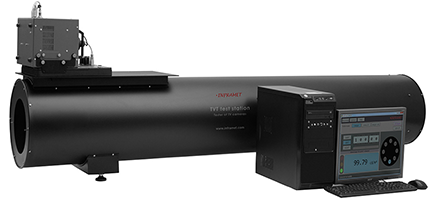
The TVT test station is a variable intensity image projector that projects images of standard targets to the tested VIS-NIR camera. The tested camera generates copies of the projected images. Quality of the images generated by the camera is evaluated and its important characteristics are measured. TVT systems are built from the following blocks: DAL series calibrated light source, set of targets, rotary wheel, set of exchangeable refractive/reflective collimators, PC, frame grabber, TAS-V software, OS stage. TVT systems are recommended for testing VIS-NIR cameras used for medium/long-distance surveillance. They can be delivered in several versions optimized for different applications (day, night, day/night) and different camera designs.
a)
b)
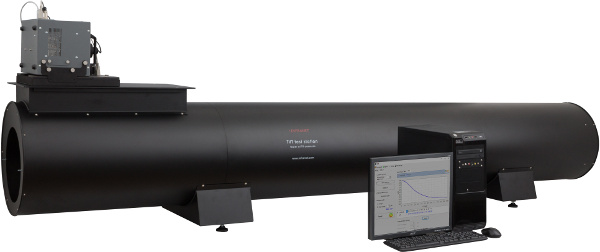
Fig.1. Photo of TVT test systems: a)TVT200, b)TVT3000
TVT stations are characterized by a series of technical parameters that make them suitable for international markets, and the TVT system has become a preferred choice for both manufacturers, research teams, and end users of long/medium-range VIS-NIR cameras.
VINIS system can be treated as a simplified version of the TVT system. More precisely, it is a cost-effective solution for testing VIS-NIR cameras and SWIR imagers. It is based on a manual halogen light source coded as LS-MAH (non-calibrated in basic version) in contrast to a computerized calibrated DAL light source. Targets are manually inserted, while in the TVT system targets are automatically exchanged using MRW-8 rotary wheel. VINIS is typically delivered as an image projector without PC and test software (these blocks can be provided by the customer if needed). These design changes enable significant cost reduction compared to the TVT system. At the same time LS-MAH light source is offered in several versions, allowing optimization for different applications.
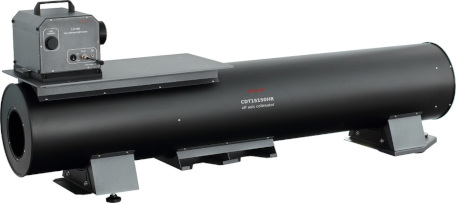
Fig.2. Photo of VINIS150 test system
The VLOF measuring set is a mobile variable-distance measuring system that projects images of a set of standard targets directly to the tested VIS/NIR camera. The tested camera generates distorted copies of the projected images. Quality of the images generated by the VIS-NIR camera is evaluated and its important characteristics are measured.
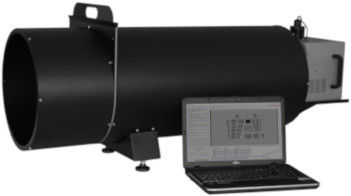
Fig.3. Photo of VLOF test system
Learn more:
- Data sheets: TVT, VINIS, VLOF
- Customer questionnaires for systems for testing VIS-NIR cameras
- Recommendations on environmental conditions for Inframet test systems
- Educational section
- Inframet Info section
- Newsletter
- Contact INFRAMET