
Discrete detectors
TRAL test station is a quasi-universal test station designed to measure parameters of discrete (or small linear array) infrared detectors sensitive in a wide spectral range from about 700nm to about 16 000 nm (NIR/SWIR/MWIR/ LWIR detectors or broadband non selective detectors). All main types of infrared detectors can be tested: photonic detectors:
photovoltaic/photoreconductive, cooled/non-coooled, thermal detectors, pyroelectric detectors etc.
TRAL test station is a modular system that can work in work in three main configurations: Radiometric configuration, Spectral configuration, and Spatial configuration. The latter one is considered as an optional configuration. Each configuration enables measurement a different set of parameters of discrete/linear infrared detectors.
|
|
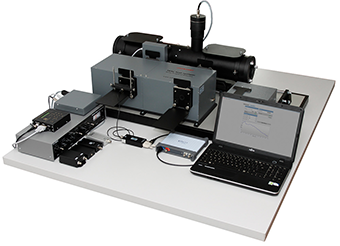 |
Photos of TRAL test station in two different configurations: a) radiometric configuration, b) spectral configuration |
|

In radiometric configuration TRAL station irradiates tested IR detector using a modulated beam. The detector generates output electrical signal proportional to power of incoming infrared radiation. Analysis of measured output electrical signal and power of radiation incoming to tested detector enables calculation of radiometric parameters of tested detector: blackbody responsivity, responsivity, blackbody detectivity, normalized detectivity, NEP, dark current, Quantum Efficiency.
In spectral configuration TRAL station irradiates the tested detector using variable wavelength, variable intensity radiation. Analysis of electrical signal at output of tested IR detector enables determination of relative spectral sensitivity of this detector.
Spatial configuration is used to determine spatial
parameters of IR detectors: modulation transfer function
MTF and responsivity non uniformity. In this mode TRAL
projects images of edge/pinhole targets of controlled
intensity and spatial position on tested detector.
Analysis of signal generated by the detector enables
determination of both MTF and non uniformity.
Data sheet:
If you have further questions please contact us.